
Study Abroad Guide
For Fontys ICT
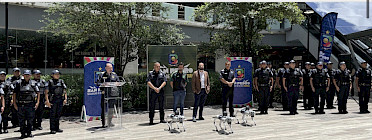 How do you ensure that, as the local police force, you can make yourself understood by people of all nationalities visiting your country during the World Cup? The police in Mexico developed an AI translator that converts all speech into the desired language. However, before it could be put into use, testing was of the utmost importance. And that is where ICT student Baraa Salaymeh played a key role.
Baraa was studying a minor at the Mexican Institute of Technology and Higher Studies – known as Tec de Monterrey for short – in the city of Monterrey. That is also where the football stadium is located, which hosted matches including Tunisia v Japan, South Africa v South Korea and, of course, the Netherlands v Morocco.
To help and assist all football fans of these different nationalities, the Mexican police developed an AI translator. But it still needed to be tested. “That’s why I received a call from my university’s International Student Office,” says Baraa. “They asked if I’d like to help test the translator because I speak Arabic, and an Arab country was due to play here in Monterrey. Other international students who spoke Korean or Japanese, for example, were also invited.”
Automatic translation
And so it came to pass. Baraa took part in a demonstration in which several police officers were standing in a row. They were all wearing bodycams, and it was up to the student to ask one of them a question in Arabic. “That officer pressed a button which automatically recognised my language and translated it into Spanish. The officer then replied in Spanish, which was in turn translated back into Arabic by the bodycam, so that I knew what he was saying.”
The questions Baraa had to ask were typical tourist enquiries. “Such as how to get to the stadium, for example, or the location of a particular hotel. Because those kinds of questions would also be asked by World Cup visitors.”
English is not a given
Following the ‘training day’ – during which the mayor of Monterrey and the police chief also explained how the tool worked and robot dogs were demonstrated – the AI translator was actually put to use during the World Cup. This was an important addition, according to Baraa, as it is by no means a given that the Mexican police and local population speak English.
According to the ICT student – who, prior to this experience, had already implemented AI on several occasions during his studies and had also taken a semester-long course in Generative AI at Fontys – the tool worked perfectly. “I’ve now seen with my own eyes in Mexico just how valuable AI can be. Especially in a situation where it makes communication between people who don’t speak the same language a lot easier. What impressed me most was how easy the tool was to use and how quickly it responded. That really broke down the language barrier.”